


Soybean and peanut processors need reliable equipment to remove impurities and improve the consistency of their raw materials. Incoming crops may contain dust, leaves, small stones, broken seeds, and lightweight or underdeveloped seeds. The type and quantity of impurities can vary significantly between suppliers, harvest conditions, and crop varieties.
A soybean seed cleaning machine or peanut seed cleaning machine can help remove unwanted materials before the crop moves to storage, grading, packaging, or further processing. For operations that require more than basic screening, combining air-screen cleaning with gravity separation can provide a more comprehensive approach.
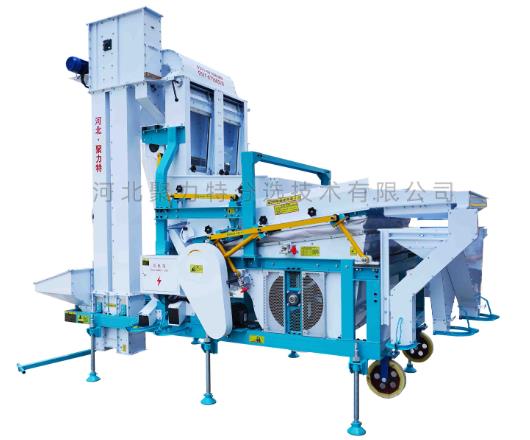
Hebei Julite Sorting Technology Co., Ltd. offers a combined cleaning machine that integrates an air-screen cleaner, gravity table, and vibration grader. This type of equipment is worth evaluating for soybean, peanut, and sesame processing applications where several cleaning functions are needed in a coordinated system.
A single screening operation cannot necessarily remove every type of impurity. Some contaminants differ in size, some are lighter than the target crop, and others may have a similar size but a different density.
A multi-stage soybean and peanut cleaning machine addresses these different separation requirements by combining complementary cleaning methods.
Air-screen cleaning uses airflow and screens to separate materials according to their aerodynamic properties and size. It can help remove dust, chaff, leaves, and other lightweight contaminants, while screening separates oversized and undersized particles.
This stage is useful when raw soybeans or peanuts contain mixed agricultural debris that needs to be removed before further processing.
Some defective seeds have dimensions similar to those of sound seeds. Screening alone may not separate them effectively.
A seed cleaner with gravity separator uses differences in physical properties, particularly density, to separate material fractions. Depending on the incoming crop and operating conditions, this can help separate lighter, damaged, or poorly developed seeds from heavier material.
A vibration grader separates material into different size fractions using screens with appropriate openings. This can help processors prepare more uniform products for subsequent operations.
The required grading arrangement depends on the crop variety, product specifications, and the number of size classes needed.
Julite's 5XFZ-25S Air Screen Cleaner with Gravity Table and 5XFJ-10C Vibration Grader combines several processing functions in one equipment configuration.
According to the manufacturer's product information, the system is designed to remove dust, leaves, lightweight impurities, and larger impurities, while gravity separation helps remove certain defective seed fractions.
The air-screen section removes lightweight impurities and separates particles through screening. This helps prepare the material for subsequent separation stages.
The gravity table separates material according to differences in physical characteristics, including density. It can help remove certain blighted, damaged, or underdeveloped seeds when sufficient separation differences exist.
Actual separation results depend on the incoming material and correct machine adjustment.
The vibration grader separates material into different size fractions. This function is useful when processors need more consistent sizing in addition to impurity removal.
By combining these stages, the equipment can support several cleaning functions without requiring each operation to be performed on a completely separate machine.
For product details, see Julite's 5XFZ-25S Air Screen Cleaner with Gravity Table and 5XFJ-10C Vibration Grader.
When comparing soybean cleaning equipment and peanut cleaning systems, buyers should review capacity, power requirements, dimensions, and the intended application.
The manufacturer's published specifications for this combined system are as follows:
| Parameter | Published Specification |
|---|---|
| Equipment model | 5XFZ-25S with 5XFJ-10C Vibration Grader |
| Main functions | Air-screen cleaning, gravity separation, vibration grading |
| Power | 13.6 kW |
| Listed capacity for seeds | 10 t/h |
| Listed capacity for commodity grains | 15 t/h |
| Voltage | 380 V, 50 Hz, three-phase |
| Overall dimensions | 7140 × 2790 × 3740 mm |
| Weight | 3400 kg |
The actual throughput depends on the crop, impurity level, required cleaning standard, and operating conditions. Buyers should confirm the final configuration and expected capacity with the manufacturer before ordering.
Soybeans are used in food production, feed manufacturing, oil processing, and other agricultural applications. Depending on the final product, processors may need to remove foreign materials, separate damaged beans, or classify the cleaned product.
A suitable soybean cleaning machine can be selected according to the condition of the incoming crop and the required output.
Remove dust, leaves, and lightweight agricultural residues.
Separate oversized and undersized particles.
Reduce the presence of certain lightweight or defective beans.
Prepare the material for storage, grading, or further processing.
Not every soybean plant requires the same equipment combination. For example, a facility performing only preliminary cleaning may need a simpler machine than a plant supplying a more tightly graded product.
Buyers should define the target cleanliness and size requirements before selecting the cleaning system.
Peanuts can contain soil, plant residues, stones, broken material, and other impurities after harvesting. These contaminants may affect downstream handling and the consistency of the finished product.
A peanut seed cleaning machine can help prepare peanuts for storage, grading, packaging, or additional processing, depending on the intended application.
Impurity removal: Air-screen cleaning can help remove dust, leaves, and particles that differ in size or airflow behavior.
Density-based separation: A gravity table may help separate certain lighter or defective material fractions when their physical properties differ sufficiently from the target peanuts.
Size grading: Vibration grading can classify peanuts into size fractions when the final product requires size consistency.
Material handling: Feed rate, transfer points, and discharge arrangements should be evaluated to avoid unnecessary mechanical damage.
The best equipment configuration depends on whether the plant handles raw peanuts, shelled kernels, or another intermediate product. Buyers should clarify the material condition before requesting a quotation.
Some processors only need to improve one stage of their existing operation. Others require a coordinated system that transfers materials through several processing stages.
| Buyer Requirement | Possible Equipment Approach |
|---|---|
| Remove dust and lightweight impurities | Air-screen cleaner |
| Separate material by size | Vibration grader |
| Separate certain lightweight or defective fractions | Gravity separator |
| Combine several cleaning functions | Air-screen cleaner with gravity table and grader |
| Coordinate multiple stages in a processing plant | Customized cleaning line with suitable conveying equipment |
A standalone peanut cleaning machine or soybean cleaner may be sufficient when the existing plant already has compatible downstream equipment.
For a new project, a soybean cleaning line can be planned around the required processing sequence, target throughput, installation space, and final product specifications.
Julite also provides a grain and beans cleaning plant that illustrates how air-screen cleaning, magnetic separation, destoning, gravity separation, grading, color sorting, and packaging can be arranged as parts of a larger processing system. The final equipment list should be tailored to the actual material and project requirements.
Before purchasing a seed cleaning machine, buyers should prepare several key details. This helps the supplier assess the application and recommend equipment that matches the actual production requirements.
Specify whether the material is soybean, peanut, or another crop. For peanuts, clarify whether the equipment will process unshelled peanuts or shelled kernels.
Provide information about the main impurities, average particle size, and material condition wherever possible.
State the target throughput in tons per hour. The capacity of each machine in a complete line should be coordinated so that one stage does not restrict the entire operation.
Explain whether the main goal is preliminary cleaning, fine cleaning, size grading, density separation, or a combination of these functions.
Clear objectives help determine whether a single machine or a multi-stage system is more suitable.
Confirm the available floor space, installation height, power supply, inlet and outlet positions, and connections to existing equipment.
These details are particularly important when replacing a machine or integrating new equipment into an operating plant.
If the incoming crop contains a complex mixture of impurities or requires a specific separation result, ask whether the supplier can evaluate a representative material sample.
Testing can help establish realistic expectations for capacity and cleaning performance before the equipment configuration is finalized.
Hebei Julite Sorting Technology Co., Ltd. specializes in grain cleaning and seed processing equipment. Its product range includes air-screen cleaners, gravity separators, destoners, magnetic separators, vibration graders, elevators, and complete grain and seed processing systems.
For commercial buyers, the value of a suitable equipment supplier lies in matching machine functions to the processing objective rather than simply selecting equipment based on a product name.
When evaluating Julite's seed cleaning equipment, buyers can provide their crop type, capacity requirements, target cleaning results, and plant layout for further discussion.
Explore the Julite grain and seed cleaning equipment catalog to review available machines and processing options.
Both can use screening and airflow to remove impurities, but the appropriate configuration depends on the crop's physical characteristics and the required result. Peanut processing also requires clarification of whether the material is unshelled or shelled.
Some equipment configurations can handle both crops, provided that the machine is suitable for their size, shape, and handling requirements. Screen settings and operating parameters may need to be adjusted when switching materials.
A gravity separator separates material according to differences in physical characteristics, particularly density. It may help separate certain defective or lightweight fractions that cannot be removed effectively by screening alone.
The published specifications list 10 t/h for seeds and 15 t/h for commodity grains. Actual capacity should be confirmed for the specific material and required cleaning result.
Not necessarily. A standalone machine may be adequate if only one processing stage needs improvement. A complete line is worth considering when several operations need to be coordinated or a new processing plant is being planned.
Choosing the right soybean seed cleaning machine or peanut seed cleaning machine starts with understanding the raw material, impurity types, required capacity, and desired cleaning result.
For operations that need screening, airflow separation, density-based separation, and grading, a combined system such as Julite's 5XFZ-25S Air Screen Cleaner with Gravity Table and 5XFJ-10C Vibration Grader is an option to evaluate. Larger projects can also consider a coordinated cleaning line designed around the plant's processing requirements.
Contact Hebei Julite Sorting Technology Co., Ltd. to discuss your crop type, target capacity, and equipment requirements.
Contact Julite
Email: export@julite.com
Phone: +86-311-85155319 / +86-311-85155320
WhatsApp: +86 159 3015 0766
Website: https://www.julite.com/
Hot Tags: soybean seed cleaning machine, peanut seed cleaning machine, soybean cleaning equipment, peanut cleaning equipment, seed cleaner with gravity separator, soybean cleaning line, peanut processing equipment, seed cleaning machine manufacturer, seed cleaning equipment supplier
Processing demand survey
x