


Not all impurities in grain and seeds can be removed by size or airflow alone. Some materials may have a similar size to the good product but differ significantly in density. Moldy grains, insect-damaged seeds, immature seeds, lightweight kernels and certain heavy impurities can remain after conventional screening.
A gravity separator is designed to address this type of separation problem.
By combining airflow, vibration and an inclined separation surface, a gravity separator separates granular materials according to differences in specific gravity. This makes it useful for grain and seed processors that need to improve material uniformity after preliminary cleaning.
Hebei Julite Sorting Technology Co., Ltd. manufactures gravity separators for grain and seed processing, with models including 5XZ-6, 5XZ-8 and 5XZ-15. The equipment can be used for beans, sesame, wheat, peanuts, corn, maize and sunflower seeds.
A gravity separator machine is a grain cleaning and seed processing machine that separates particles according to differences in specific gravity.
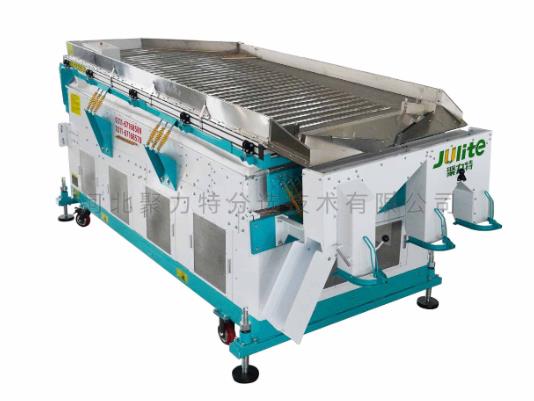
Two materials may have similar dimensions but different internal conditions. For example, a healthy grain kernel can be heavier and denser than a damaged, immature or insect-affected kernel of a similar size.
A gravity separator uses controlled airflow and mechanical vibration to create a separation environment in which materials with different densities move differently across the working surface.
The result is a separation between relatively heavy and light fractions.
This makes gravity separation different from ordinary screening, where the main separation factor is particle size.
The working principle of a grain gravity separator involves several physical forces acting on the material.
After the grain or seed enters the machine, it is distributed across the separation surface. Air passes through the material while the table vibrates.
Under the combined influence of airflow, vibration, gravity and friction, particles with different densities behave differently.
The key factor is not simply whether one particle is large or small.
A damaged seed may have a similar size to a sound seed but contain less solid material. Its density can therefore be different.
The gravity separator uses this physical difference to divide the material into different fractions.
Air pressure affects how particles behave on the separation table.
The airflow needs to be adjusted according to the material being processed because excessive or insufficient air can affect the separation result.
The vibration of the working surface helps distribute and move the material across the table.
Together with the airflow and table inclination, vibration contributes to the separation of different-density particles.
A gravity separator is particularly useful when unwanted material differs from the good product mainly in density.
Depending on the raw material, it can help separate:
Lightweight grains
Immature seeds
Mold-affected grains
Insect-damaged seeds
Low-density kernels
Certain heavy foreign materials
Other materials with different specific gravity
The actual separation result depends on the physical characteristics of the raw material and the machine settings.
A gravity separator should therefore be considered a specific separation stage, rather than a universal replacement for every grain cleaning machine.
An air-screen cleaner and a gravity separator perform different jobs.
An air-screen cleaner primarily uses screening and airflow to separate materials according to size and aerodynamic properties.
A gravity separator focuses more on differences in density.
For example, two seeds can have nearly identical dimensions but different densities. A screen may not separate them effectively because they can pass through the same opening.
The gravity separator can provide another level of separation based on their physical density.
This is why both machines can appear in the same grain cleaning line without performing exactly the same function.
A destoner machine is mainly used to separate stones and other heavy materials from grain or seed.
A gravity separator has a broader density-separation function.
A destoner may be used when the primary concern is removing stones, soil particles and heavy foreign materials.
A gravity separator can be used when the processor wants to divide the main product according to differences in density, such as separating sound grain from lightweight or damaged material.
In some complete cleaning systems, both machines can be used at different stages.
Julite's gravity separator range is designed for multiple grain and seed applications, including beans, sesame, wheat, peanuts, corn and sunflower seeds.
In wheat processing, density separation can help separate sound wheat kernels from lighter or damaged kernels after preliminary cleaning.
The machine can therefore serve as a quality-oriented separation stage within a larger wheat cleaning system.
Corn kernels can vary in density because of differences in maturity, damage and physical condition.
A corn gravity separator can be incorporated after initial cleaning when density-based separation is required.
Beans with different physical conditions can sometimes have noticeable density differences.
A bean gravity separator can therefore be used as part of a bean cleaning and sorting system.
Sesame processing may require additional separation after basic cleaning.
A sesame gravity separator can help separate lighter or lower-density material from the main sesame product stream when the physical characteristics allow effective density separation.
Peanuts can also be processed with gravity separation equipment.
Depending on whether the system handles whole peanuts or kernels, the machine configuration and separation requirements should be evaluated according to the actual material.
Sunflower seeds can vary in density and physical condition.
A sunflower seed gravity separator can be incorporated when density-based cleaning or classification is required.
A gravity separator is usually not the first machine in a complete processing line.
The raw material often needs preliminary cleaning before entering the gravity table.
A typical arrangement may be:
Raw Material → Air-Screen Cleaning → Magnetic Separation → Destoning → Gravity Separation → Grading → Color Sorting
However, this is only one possible configuration.
The actual sequence should depend on the impurities present in the raw material and the desired final product.
For example, if the incoming material contains a significant amount of dust and large foreign materials, preliminary screening should normally address those materials before density separation.
If the main concern is lightweight or damaged grain, gravity separation may become a more important stage.
One of the main reasons processors add a gravity separator is that size alone does not always indicate material quality.
Consider two wheat kernels with almost the same dimensions.
One may be a dense, sound kernel.
The other may be lightweight because of incomplete development, insect damage or other physical conditions.
A conventional screen may treat both kernels as the same size.
A gravity separator provides another way to distinguish them by their density.
This makes density separation particularly useful when the objective goes beyond basic foreign-material removal.
Julite currently lists three main gravity separator models:
| Model | Listed Capacity | Typical Position |
|---|---|---|
| 5XZ-6 Gravity Separator | 6 t/h class | Medium-capacity density separation |
| 5XZ-8 Gravity Separator | 8 t/h | Grain and seed density separation |
| 5XZ-15 Gravity Separator | 15 t/h class | Higher-throughput processing |
The actual capacity achieved in production depends on the material being processed, its condition and operating parameters.
For example, Julite's 5XZ-8 model is listed with an 8 t/h capacity, a 13.95 kW power requirement and a 1380 × 3150 mm sieve size. The machine allows adjustment of parameters such as wind pressure and amplitude.
For a project requiring a specific throughput, the manufacturer should evaluate the raw material and processing conditions rather than selecting a model from capacity alone.
Selecting a gravity separator machine starts with understanding what needs to be separated.
Different grains and seeds have different physical properties.
Tell the supplier whether the material is wheat, corn, sesame, peanut, bean, sunflower seed or another agricultural product.
The next question is what type of material needs to be removed.
For example:
Lightweight grain
Immature seed
Mold-affected grain
Insect-damaged seed
Other low-density material
This information helps determine whether gravity separation is appropriate.
Processing capacity is another major consideration.
Julite's processing demand survey currently includes capacity ranges from 1–5 t/h through 16–30 t/h, allowing equipment planning to start from the required processing volume.
If a customer already has an air-screen cleaner or destoner, the gravity separator does not necessarily need to duplicate those functions.
Instead, it can be integrated into the existing processing sequence as a density-separation stage.
A seed-processing project may have different separation requirements from grain intended for oil production or food processing.
The final application should therefore be included when discussing equipment configuration.
Yes, depending on the processing requirements.
A gravity separator can be used as an individual machine when a processor already has preliminary cleaning equipment and only needs an additional density-separation stage.
For example, a facility may already have:
Air-Screen Cleaner + Destoner
but still find that lightweight or damaged grains remain in the product.
A gravity separator can then be added to address the density difference.
For a new processing facility, however, the machine may be integrated into a complete grain or seed cleaning line.
Density separation can be particularly useful in seed processing because physical condition can affect the density of individual seeds.
A seed cleaning line may use different machines for different separation tasks.
Screening handles size differences.
Air separation handles lightweight impurities.
Destoning handles stones and heavy foreign material.
Gravity separation handles density differences.
Color sorting handles selected visual differences.
This division of functions allows each machine to contribute to a particular stage of the overall seed-processing process.
Hebei Julite Sorting Technology Co., Ltd. specializes in grain cleaning and seed processing equipment and lists gravity separators among its main product categories. The current product range includes 5XZ-6, 5XZ-8 and 5XZ-15 models.
Julite's equipment range also includes air-screen cleaners, destoners, magnetic separators, vibration graders, polishing machines, color sorters, packing machines and complete processing lines. This allows a gravity separator to be considered either as an individual machine or as part of a broader grain and seed processing system.
For buyers searching for a gravity separator manufacturer in China, the most important information to provide is the raw material, required capacity, target separation and existing processing equipment.
To help a gravity separator supplier recommend a suitable model, prepare the following information:
| Information | Example |
|---|---|
| Raw material | Wheat, corn, beans, sesame, peanut |
| Capacity | 5 t/h, 8 t/h, 15 t/h |
| Main problem | Lightweight grain, damaged seed, immature material |
| Existing equipment | Cleaner, destoner, grader |
| Final purpose | Seed, oil processing, food processing, pre-cleaning |
| Required configuration | Standalone machine or complete line |
| Electrical conditions | Voltage and frequency |
| Installation | Available workshop space |
A raw-material sample or detailed description of the incoming material can also help the supplier understand the separation requirements.
A gravity separator is used to separate grain and seeds according to differences in specific gravity, particularly when materials have similar sizes but different densities.
Gravity separators can be used for many grains and seeds, including wheat, corn, beans, sesame, peanuts and sunflower seeds, depending on the machine configuration and material characteristics.
A destoner mainly targets stones and other heavy foreign materials, while a gravity separator is designed more broadly for density-based separation of different fractions within grain or seed material.
It can help separate lower-density material such as certain mold-affected, immature or damaged grains when their physical density differs sufficiently from sound grain.
The required model depends on the target throughput and the characteristics of the material. Julite offers 5XZ-6, 5XZ-8 and 5XZ-15 gravity separator models.
Yes. It can be combined with air-screen cleaners, destoners, graders, color sorters and other equipment according to the processing requirements.
A gravity separator provides a different type of separation from conventional screening and air cleaning. Its main function is to exploit differences in material density, making it useful for separating lightweight, immature, damaged or otherwise lower-density grain and seed fractions.
For wheat, corn, beans, sesame, peanuts, sunflower seeds and other agricultural products, the machine can be used as an individual density-separation unit or integrated into a larger cleaning and processing line.
Hebei Julite Sorting Technology Co., Ltd. provides gravity separator machines for grain and seed processing, including 5XZ-6, 5XZ-8 and 5XZ-15 models. The appropriate configuration can be considered according to raw material, capacity, separation objective and existing equipment.
Gravity Separator, Gravity Separator Machine, Grain Gravity Separator, Seed Gravity Separator, Gravity Separator Manufacturer, Gravity Separator Supplier, Gravity Separator China, Grain Gravity Separator Manufacturer, Seed Cleaning Machine, Grain Cleaning Equipment, Grain Cleaning Machine Manufacturer, Seed Processing Equipment, Wheat Gravity Separator, Corn Gravity Separator, Maize Gravity Separator, Bean Gravity Separator, Sesame Gravity Separator, Peanut Gravity Separator, Sunflower Seed Gravity Separator
Processing demand survey
x